The Battle Over the Second Amendment Isn't Just About Guns. It's About Words.
The side that defines the words usually defines the debate.

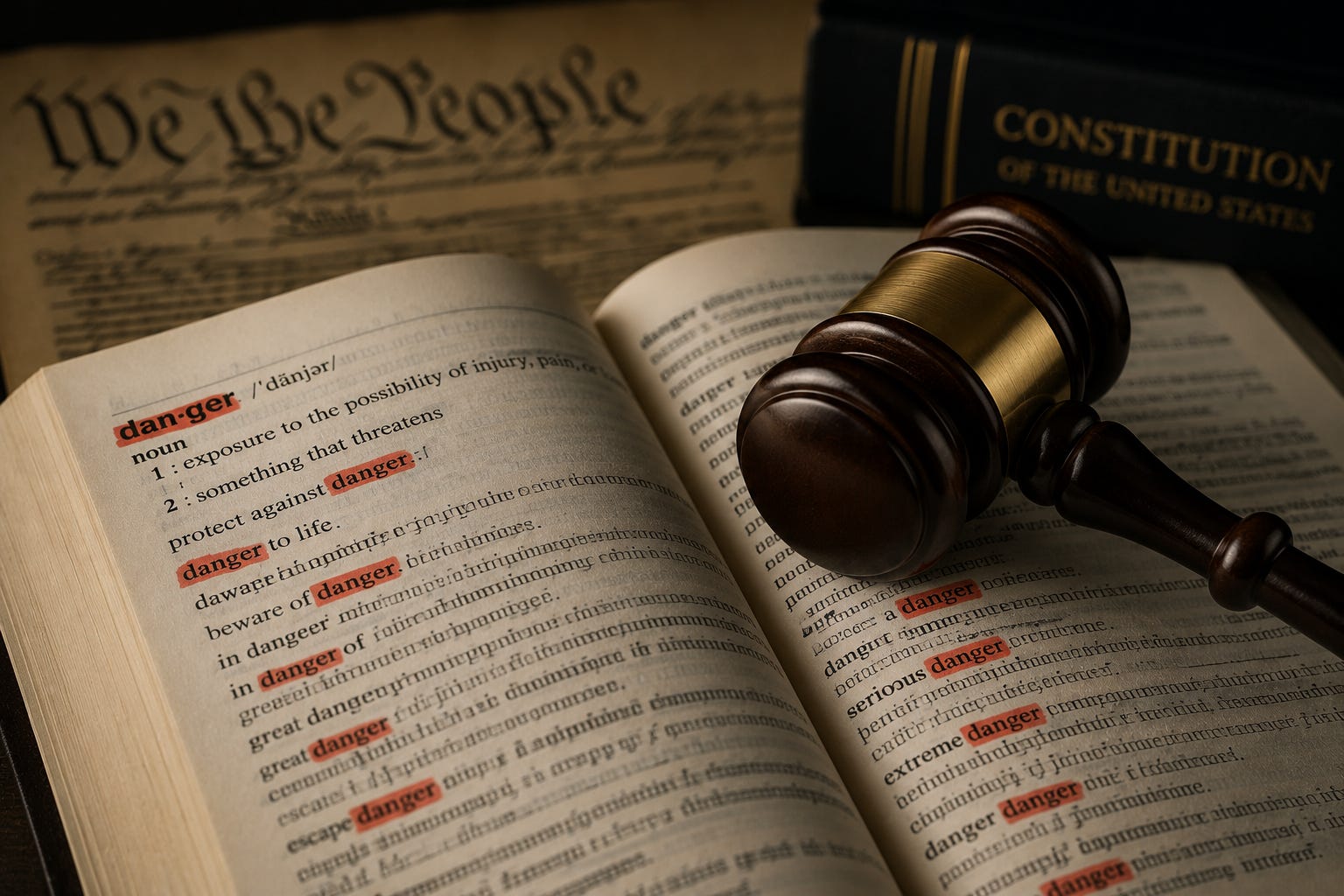
The Battle Over the Second Amendment Isn’t Just About Guns. It’s About Words.
A Personal Note
If you’ve followed me over the years, you’ve probably noticed that I pay close attention to words.
There’s a reason.
I’ve long believed that one of the greatest strengths of the political left is its disciplined use of language. It understands that words shape perception long before facts, history, or constitutional arguments enter the discussion.
Too often, those of us on the right have failed to recognize that. Worse, we repeatedly adopt our opponents’ terminology simply to argue against it. In doing so, we reinforce the very language—and the assumptions behind it—that they worked so hard to establish.
This essay is an invitation to think differently about the role language plays in the battle for the Second Amendment.
One of the most revealing parts of the Seventh Circuit’s recent decision upholding Illinois’ ban on AR-15s and standard-capacity magazines isn’t the discussion of firearms at all.
It’s the discussion of Bowie knives.
The court, following the framework established by New York State Rifle & Pistol Association v. Bruen, needed to identify a historical tradition of regulating similar weapons. It settled on the Bowie knife as one of its principal historical analogues.
The opinion states:
“...we focus here instead on a leading example of this tradition: regulations of the Bowie knife—or, as one Reconstruction-era court called it, the ‘instrument of almost certain death.’”
Later, the court expands on that theme:
“Using one or another label—’dangerous and unusual,’ ‘unusually dangerous,’ ‘especially dangerous,’ ‘particularly capable of unprecedented lethality’—these courts have coalesced around a largely overlapping set of historical regulations imposing targeted restrictions on weapons whose danger and lethality stand out.”
Legally, the Bowie knife serves an obvious purpose. The court is attempting to satisfy Bruen by arguing that history contains examples of governments regulating weapons considered exceptionally dangerous. Whether that historical analogy ultimately withstands scrutiny is for the Supreme Court to decide.
But there is another aspect of this opinion that deserves just as much attention.
It is about language.
For years, I have argued that the greatest advantage enjoyed by the gun-control movement is not money, political influence, or media access.
It is framing.
Notice the words the court repeatedly uses:
Dangerous
Danger
Lethality
Instrument of almost certain death
Especially dangerous
Unusually dangerous
Particularly capable of unprecedented lethality
These are not emotionally neutral words.
The moment we see a sign that says DANGER, our brain immediately reacts. We don’t stop to ask questions. We don’t analyze statistics. We don’t consult history.
We respond emotionally first.
That is exactly why language matters.
Imagine if the opinion had instead described the Bowie knife this way:
“The Bowie knife was a commonly owned defensive arm that some jurisdictions attempted to regulate.”
That sentence communicates historical information without evoking fear.
Instead, the court deliberately quotes a Reconstruction-era description calling it an “instrument of almost certain death.” Regardless of whether that phrase accurately reflected broader public sentiment at the time, it accomplishes something rhetorically before the constitutional analysis even begins.
It frames the discussion.
By the time the reader reaches the court’s conclusion, the words danger, dangerous, and lethality have been repeated often enough that the restrictions begin to feel intuitively reasonable.
This is not unique to this opinion.
The modern gun-control movement has spent decades refining language that appeals to emotion before facts are ever considered.
Think about the phrases we hear constantly:
Gun safety
Public safety
Common-sense gun laws
Protect our children
Weapons of war
Military-style assault weapons
High-capacity magazines
Dangerous weapons
Prevent gun violence
Keep communities safe
Every one of these phrases is designed to establish a frame.
If you oppose the proposed restriction, you are no longer simply disagreeing about constitutional interpretation.
You are opposing “safety.”
You are opposing “protecting children.”
You are opposing “common sense.”
That is extraordinarily effective messaging.
Now compare that with many of the slogans embraced by Second Amendment supporters:
Come and Take It
Molon Labe
From My Cold Dead Hands
Don’t Tread on Me
I Will Not Comply
No Compromise
Live Free or Die
I understand every one of those phrases.
Many gun owners do.
But someone who is undecided—or someone who has never owned a firearm—often doesn’t.
These slogans communicate resistance and determination to those already inside the movement. They do very little to persuade someone outside it.
That is the communications gap.
One of the greatest strategic weaknesses of the Second Amendment movement is that it argues law, while the other side argues values.
We answer with Heller. They answer with children.
We answer with Bruen. They answer with safety.
We answer with text, history, and tradition. They answer with fear, compassion, and responsibility.
Court opinions are won with legal arguments.
Public opinion rarely is.
That does not mean constitutional arguments are unimportant. They are indispensable in court.
But most Americans don’t read judicial opinions. They don’t study constitutional history. They don’t analyze eighteenth-century sources. They respond to ideas that connect with values they already hold.
The gun-control movement has understood this for decades.
Whether or not one agrees with its policy proposals, it has consistently associated itself with ideas nearly everyone supports: protecting children, reducing violence, promoting safety, and saving lives.
Meanwhile, too much of the Second Amendment movement has become identified with objects, calibers, accessories, technical terminology, and court cases.
We’ve allowed ourselves to become reactive.
We spend enormous energy responding to phrases like assault weapon, gun safety, weapons of war, and dangerous weapons.
Every time we repeat our opponent’s language—even to deny it—we strengthen the frame they created.
Every time we answer the question they’ve asked, we accept the assumptions embedded in the question.
We are fighting on a battlefield our opponents created, using language they chose.
Perhaps the most important question every supporter of the Second Amendment should ask is this:
Why have we allowed our opponents to become identified with universally accepted values while we became identified with objects, calibers, and court cases?
That question deserves serious reflection.
Because until we answer it, we’ll continue winning some legal battles while struggling to win the larger conversation.
The battle over the Second Amendment isn’t just about guns.
It’s about words.
Doris, you hit the bullseye. The left, including anti-gunners efficiently use words as weapons. For instance, there is nothing wrong or bad about "high capacity" magazines. Many handguns today come with such magazines. Fifteen is a common number, while some pistols sport mags with a capacity of 23 rounds. Anti-gunners claim more people can be killed with such magazines. Is there a real difference between one 20 round mag or two 10
s? Capacity is equal. The only difference is a second or so to reject one mag and install the second. As you basically said, we accept and use their vocabulary, rather than choosing different words or pursuing our own angle of attack. Yes, we should be attacking instead of merely defending.
When anyone talks about protecting children, I often point out that school shootings, previously almost non-existent, have escalated since the "Gun Free School Zones Act" of 1990 and are now, even though still rare, a regular headline. The gun control fanatics continue to ignore schools that have armed, trained staff who carry concealed at locations where this never happens. When the left talks about guns being a leading cause of death for children, I explain what the left includes in that statistic and the info they exclude: that "children" include gang bangers and most of that stat is the 15-19 age range of these mostly fatherless boys who obtain guns illegally and endanger their communities in inner cities where gun control laws are draconian for law abiding citizens. We have to keep breaking down that language to let people know what it means. High capacity are really standard capacity mags that have been used for many decades. Young children are injured and die much more frequently from drowning in the backyard pool and other such common injuries. Women benefit the most from guns and the stats prove it. Defensive use of guns is orders of magnitude more common in our society than gun crimes; even when the CDC tried unsuccessfully to disprove it, they found it was 5-10 times more frequent than "gun crimes", and that's a lowball estimate. Keep pounding at the language, the narratives and the false claims.